
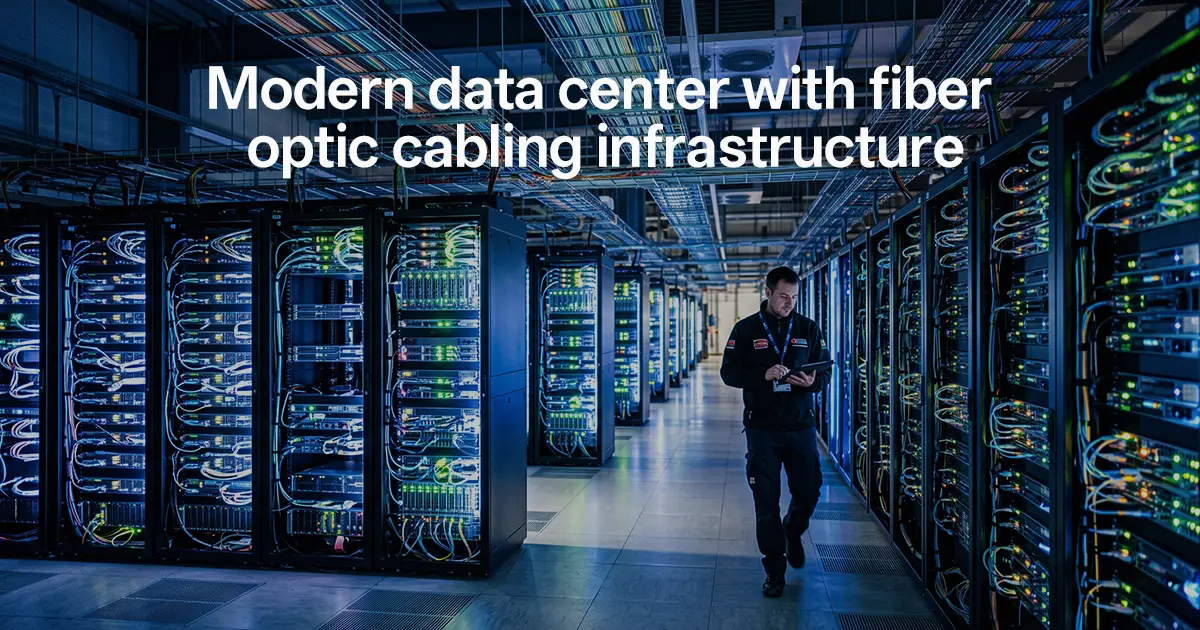
Fiber optic technology has become the foundation of modern communication infrastructure. As digital transformation continues to accelerate, businesses and organizations require faster, more reliable, and scalable network systems to support increasing data demands.
Cloud computing, artificial intelligence, 5G networks, smart cities, industrial automation, and high-definition video applications all require powerful communication infrastructure. Fiber optic cables provide the performance needed for these modern technologies by delivering high bandwidth, long transmission distances, and excellent signal stability.
Choosing the right fiber optic cable is a critical decision for any networking project. Different applications require different fiber types, cable structures, connector designs, and installation methods. Selecting an unsuitable solution may result in unnecessary costs, reduced performance, and limited future expansion capability.
This complete guide explains how to choose the right fiber optic cable according to project requirements, including fiber types, transmission distance, installation environment, connector selection, and supplier capabilities.
Whether you are a network distributor, system integrator, telecom contractor, data center operator, or enterprise customer, understanding fiber optic technology will help you build reliable and future-ready network infrastructure.
What Is a Fiber Optic Cable?
A fiber optic cable is a communication cable that uses light signals to transmit data through optical fibers. Unlike traditional copper cables that transmit electrical signals, fiber optic cables transfer information through light, allowing significantly higher bandwidth, faster transmission speeds, and longer communication distances.
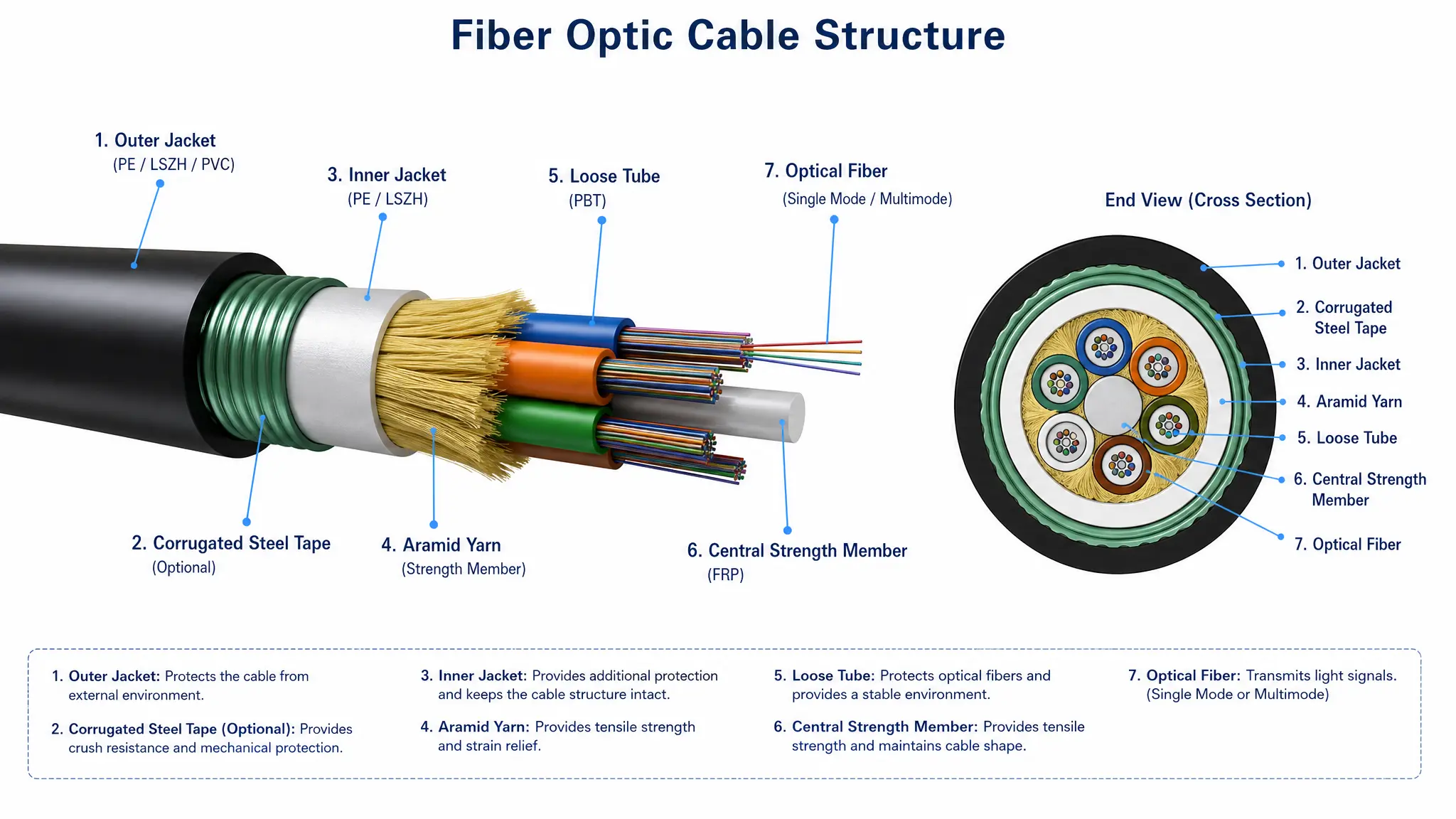
A complete fiber optic cable consists of several important layers:
Optical Fiber Core
The optical fiber core is the central part of the cable where light signals travel. The size and structure of the core determine the transmission characteristics of the fiber. Single mode fiber uses a smaller core designed for long-distance communication, while multimode fiber uses a larger core suitable for shorter distances.
Cladding
The cladding surrounds the fiber core and helps keep light signals inside the fiber through total internal reflection. This structure allows optical signals to travel efficiently with minimal loss.
Protective Coating
The protective coating provides mechanical protection for the optical fiber, guarding against bending stress, physical damage, installation pressure, and environmental impact.
Strength Member
The strength member improves the mechanical durability of the cable, protecting the internal optical fibers from excessive pulling force and external pressure during installation.
Outer Jacket
The outer jacket protects the fiber optic cable from external conditions. Common jacket materials include PVC, LSZH (Low Smoke Zero Halogen), and PE. Indoor applications often use LSZH cables for fire safety, while outdoor applications require PE jackets for moisture and weather resistance.
Why Choose Fiber Optic Instead of Copper Cabling?
Copper cabling such as CAT6 and CAT6A remains widely used in local area networks. However, as network requirements continue to increase, fiber optic technology provides significant advantages for high-performance communication systems.
Higher Bandwidth Capability
Modern businesses generate massive amounts of data every day. Applications such as artificial intelligence, cloud computing, video surveillance, data analytics, and high-speed enterprise networks require infrastructure that can handle increasing bandwidth requirements. Fiber optic cables provide much higher transmission capacity compared with traditional copper solutions, making them ideal for future-ready networks.
Longer Transmission Distance
One of the biggest advantages of fiber optic cables is their ability to transmit data over long distances with minimal signal degradation.
Resistance to Electromagnetic Interference
Because fiber optic cables transmit data through light instead of electrical signals, they are not affected by electromagnetic interference (EMI).
Improved Network Security
Fiber optic communication provides enhanced security compared with traditional copper networks.
Better Long-Term Scalability
Network requirements continue increasing every year. A properly designed fiber optic infrastructure can support future upgrades without requiring complete replacement.
Understanding Different Types of Fiber Optic Cables
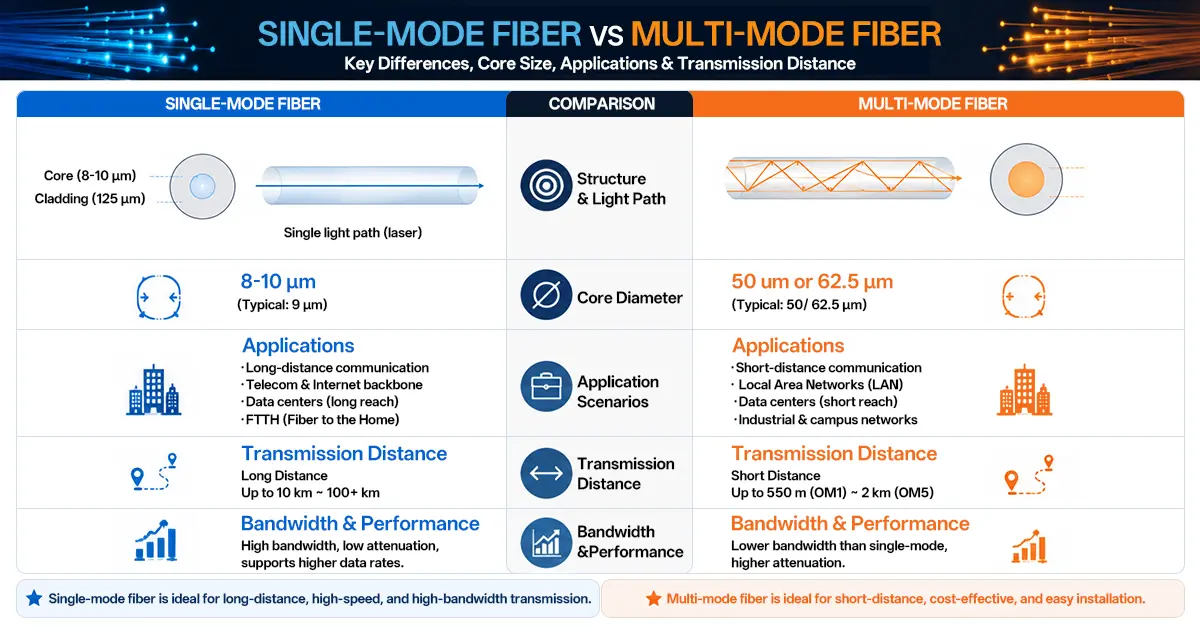
Before selecting a fiber optic cable, it is important to understand the two main categories: Single Mode Fiber (SMF) and Multi Mode Fiber (MMF).
Single Mode Fiber (SMF)
Single mode fiber is designed for long-distance and high-performance communication applications with a small optical core. Commonly used for telecommunications, FTTH, backbone networks, and data centers.
G652D Fiber
G652D is one of the most widely deployed single mode fiber standards worldwide with low attenuation and excellent transmission performance.
G657A1 and G657A2 Fiber
G657 fiber provides improved bending performance, widely used in FTTH and indoor installations.
Multi Mode Fiber (MMF)
Multi mode fiber is designed for shorter-distance applications with a larger core diameter. Common grades include OM2, OM3, OM4, and OM5. Used in enterprise networks, server rooms, data centers, and building backbone systems.
Different Types of Fiber Optic Cable Structures
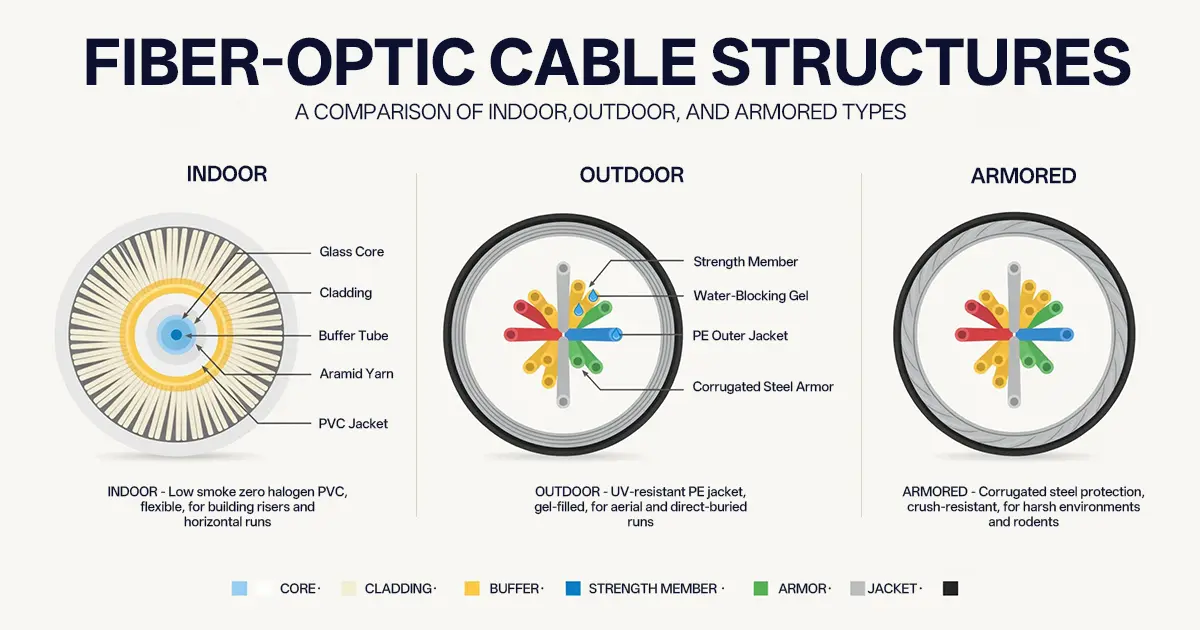
Different installation environments require different cable designs to ensure long-term reliability and performance.
Indoor Fiber Optic Cable
Designed for installation inside buildings and data centers. LSZH cables are preferred for fire safety; PVC cables for general indoor use.
Outdoor Fiber Optic Cable
Designed to withstand moisture, UV exposure, and temperature changes. Commonly use PE jackets for weather resistance.
Armored Fiber Optic Cable
Provides additional mechanical protection for industrial environments, mining, railway systems, and areas with physical risks. Advantages include strong mechanical protection, improved durability, and reduced installation risks.
How to Choose the Right Fiber Optic Connector?
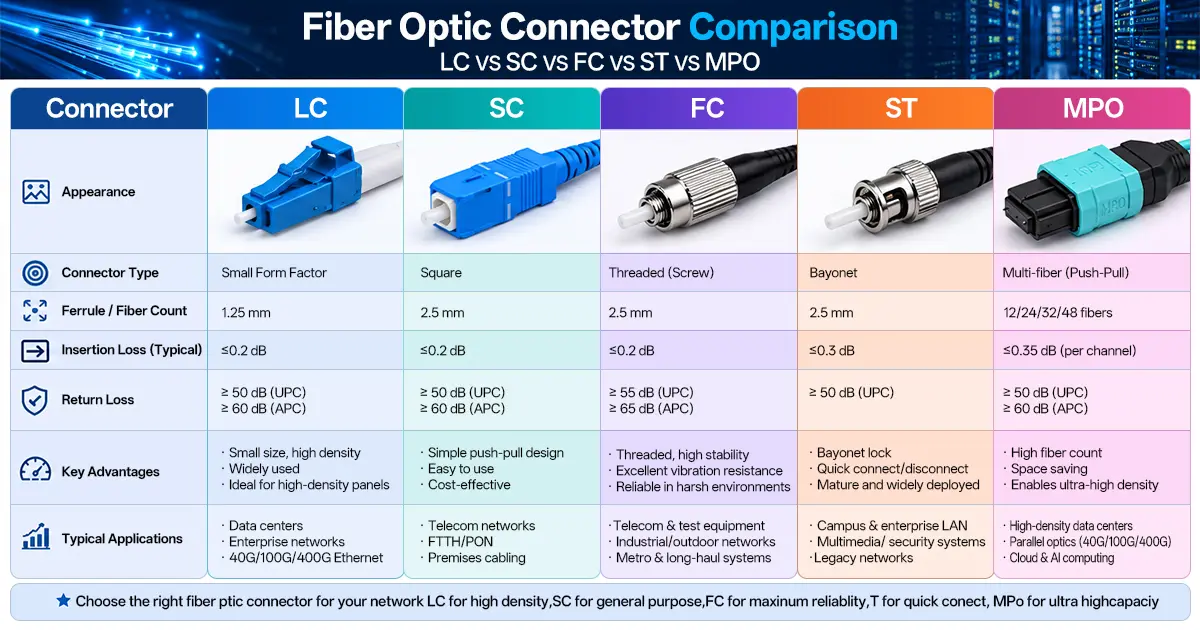
Fiber optic connectors play an important role in network performance. The connector type affects installation efficiency, signal performance, space utilization, and network maintenance.
- LC Connector — Small form factor, ideal for high-density data centers and enterprise networks
- SC Connector — Simple push-pull locking design, common in FTTH and telecom
- FC Connector — Threaded locking mechanism, vibration-resistant for industrial use
- ST Connector — Legacy connector found in earlier installations
- MPO/MTP Connector — High-density multi-fiber connectors for 40G/100G/400G networks
How to Choose the Right Fiber Count?
Fiber count depends on current network requirements, future expansion plans, project scale, and backup requirements. Common fiber counts range from 2-core for point-to-point connections to 144-core for large telecom backbone networks and data centers.
Fiber Optic Cable Applications
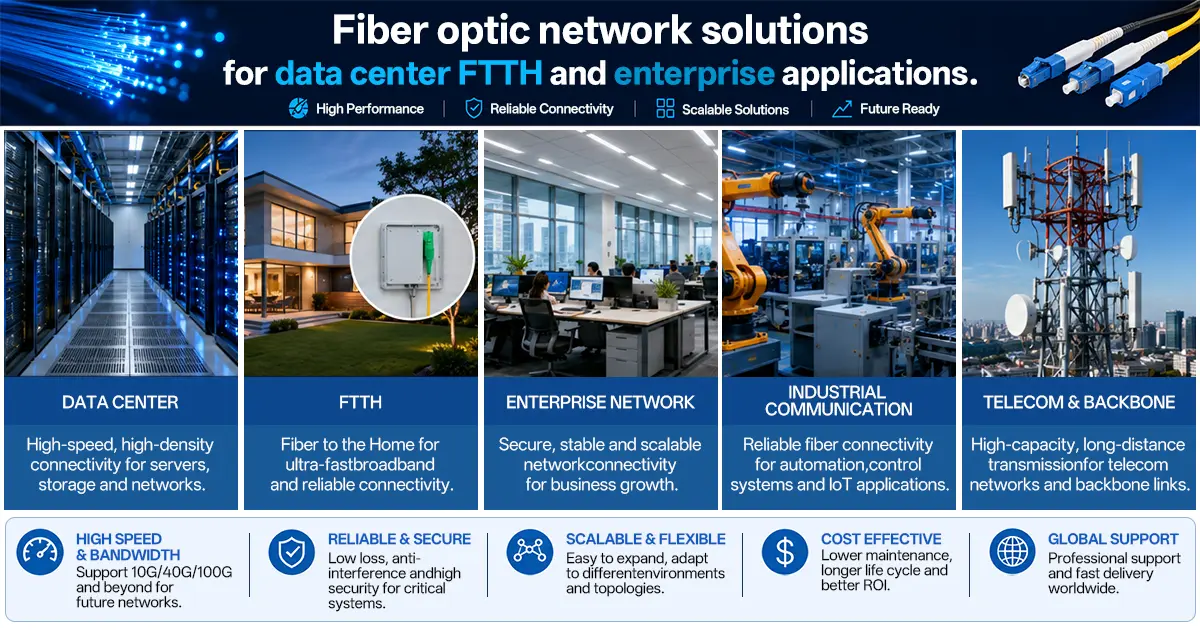
Data Center Fiber Solutions
Data centers require extremely reliable and high-performance network infrastructure for server connections, storage networks, backbone connections, and high-speed data transmission.
FTTH Fiber Solutions
Fiber To The Home (FTTH) provides high-speed internet access directly to residential users. Common products include G657 fiber cables, drop cables, and SC/APC connectors.
Enterprise Network Solutions
Modern enterprises use fiber optic solutions for office buildings, universities, hospitals, and government facilities.
Industrial Fiber Applications
Industrial environments require communication systems that can operate under challenging conditions. Fiber optic solutions are suitable for manufacturing plants, energy facilities, transportation systems, and automation networks, with advantages including EMI resistance and long-distance communication.
How to Choose a Reliable Fiber Optic Cable Supplier?
Choosing the right fiber optic supplier is an important step for ensuring project success. A professional supplier should provide high-quality products, technical support, customization capabilities, and reliable production capacity.
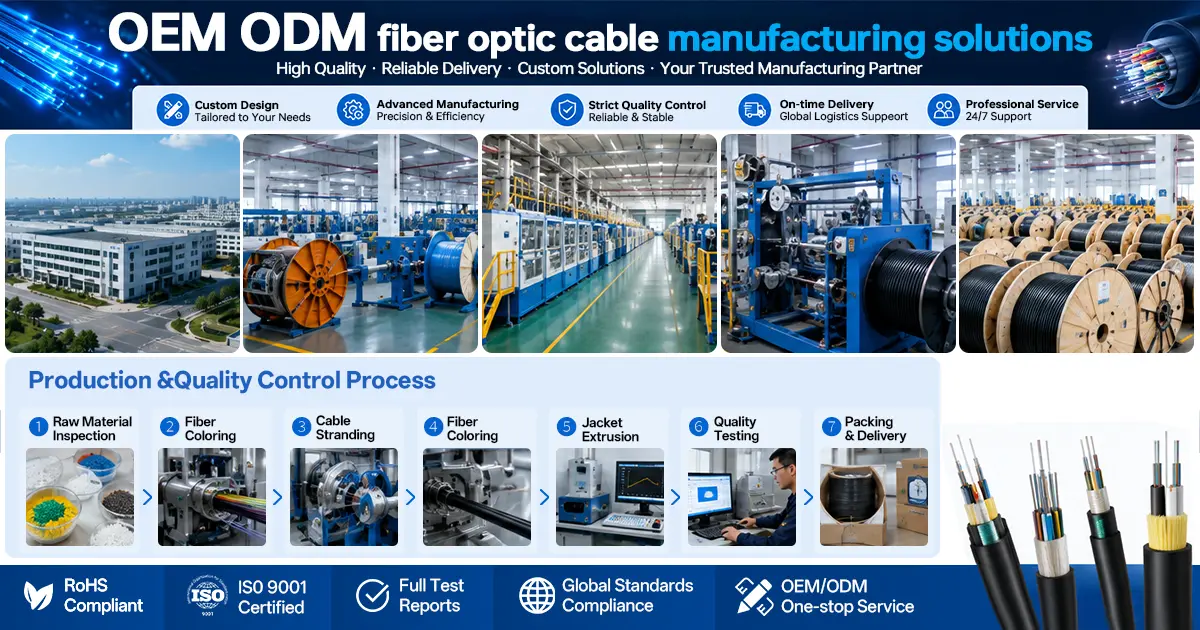
OEM and ODM Fiber Optic Solutions
Detwiler Tech provides professional OEM and ODM fiber optic solutions for global customers. With manufacturing expertise in structured cabling and fiber optic products, customized solutions can be developed according to specific project requirements. Services include product customization, project-based solutions, and private label manufacturing with brand labeling, customized packaging, product documentation, quality inspection, and export support.
Fiber Optic Cable Quality Standards and Testing
High-quality fiber optic products require strict manufacturing control including optical performance testing, mechanical testing, and certifications (ISO, RoHS, CE, IEC).
Future Trends of Fiber Optic Technology
The demand for fiber optic infrastructure continues to grow. Future data centers will require 100G, 400G, and 800G solutions. FTTH deployment continues expanding globally for smart homes, remote work, and digital services.
Frequently Asked Questions
Q: What is the difference between single mode and multimode fiber?
A: Single mode fiber is for long-distance communication, while multimode fiber is for shorter enterprise/data center applications.
Q: Which fiber cable is best for outdoor installation?
A: PE jacket or armored fiber cables for moisture and physical protection.
Q: Can fiber optic cables be customized?
A: Yes, professional manufacturers provide OEM/ODM customization.
Conclusion
Selecting the right fiber optic cable is essential for building a reliable, high-performance, future-ready network infrastructure. The correct solution depends on fiber type, transmission distance, installation environment, connector selection, fiber count, and project requirements.
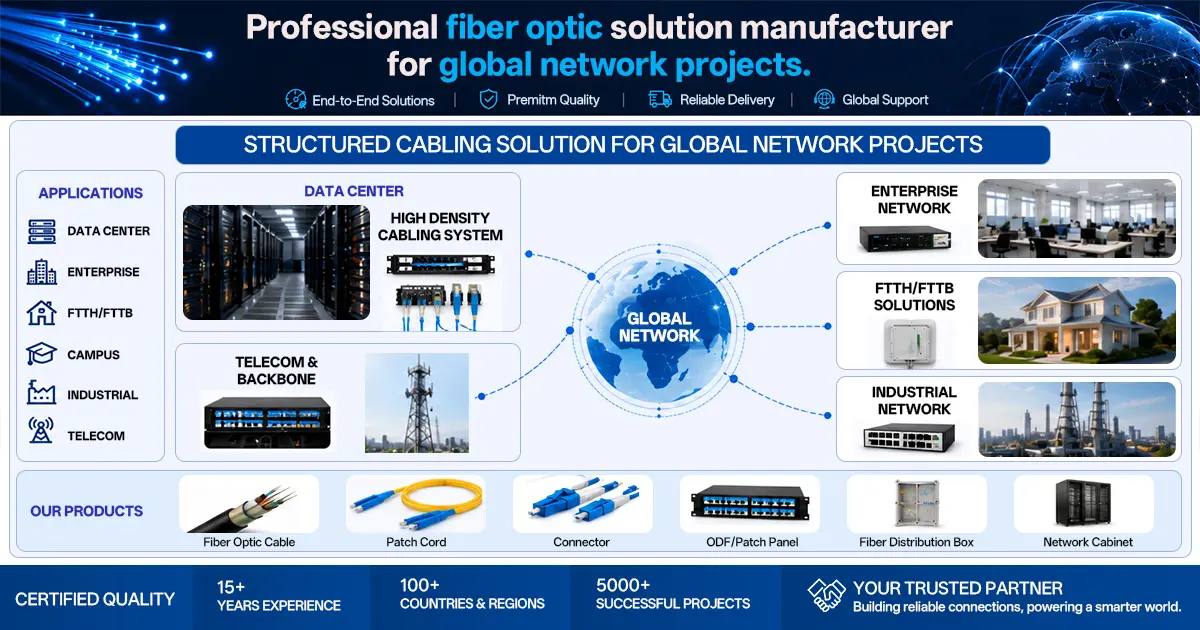
Detwiler Tech provides professional fiber optic solutions and structured cabling solutions for global customers, including OEM and ODM manufacturing services.
Need Professional Fiber Optic Solutions?
Looking for a reliable fiber optic manufacturer or customized structured cabling partner?
Detwiler Tech provides: Fiber optic cable solutions, Fiber patch cords, MPO/MTP solutions, Structured cabling systems, OEM & ODM services.
Contact Detwiler Tech today for professional Fiber Optic Solutions, Structured Cabling Solutions, and OEM & ODM manufacturing services.
WhatsApp: +86-13763103674 | Contact Us for customized product recommendations and project support.
Author: Jared Sun, Overseas Marketing Manager at Detwiler Tech — focusing on global structured cabling and fiber optic solutions, helping distributors, system integrators, and project partners develop reliable network infrastructure solutions.