



Choosing an optical transceiver begins with the link requirement, not a product photo or speed label. A module can have the right nominal rate and still be unsuitable because its form factor, fiber, wavelength, reach, connector or host coding does not match the system. This guide gives buyers a repeatable way to define the requirement before comparing quotations.
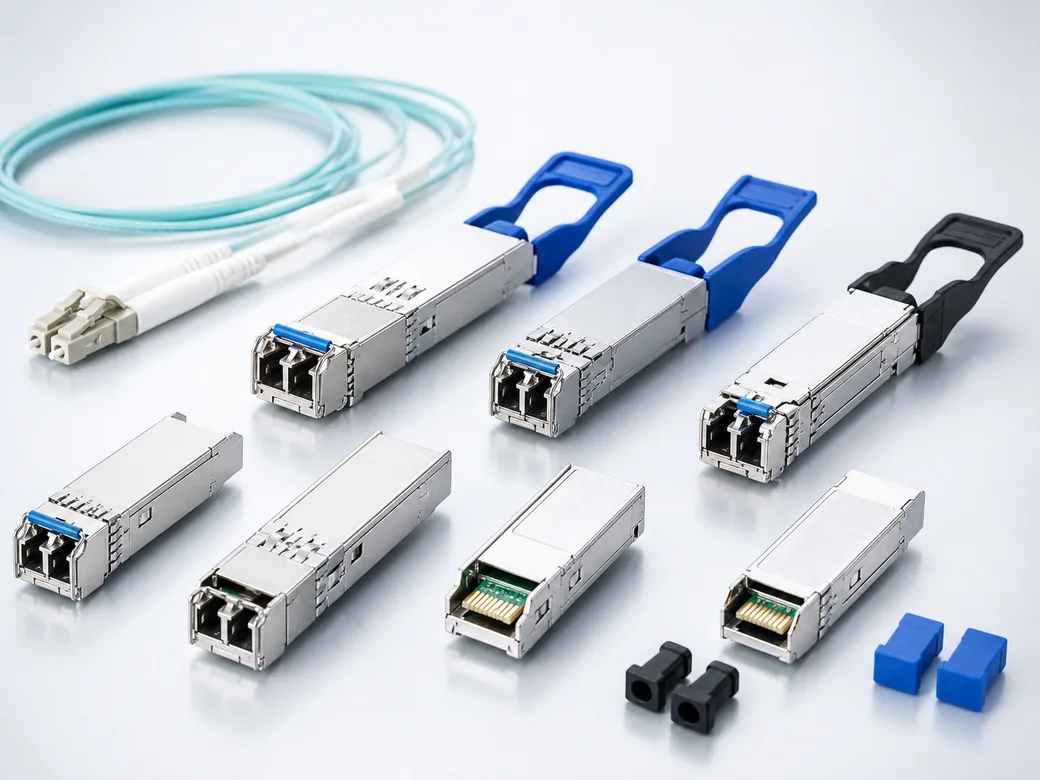
Start with equipment and the physical link
Record both ends: switch, router, server adapter or other host, plus the available port. Note the exact equipment model and an approved compatible reference if one is already in service. Then identify multimode fiber (MMF) or single-mode fiber (SMF), connector, routed distance and intermediate patching. The practical link budget includes connectors, splices and engineering margin.
Seven fields that define a transceiver
1. Form factor
Common families include SFP, SFP+, QSFP, QSFP28 and OSFP. Form factor does not alone define speed or reach. Confirm the port specification from host documentation.
2. Data rate and protocol
State both. “10G Ethernet SFP+” is more useful than “fiber module.” For higher rates, describe whether the system expects parallel optics or a wavelength-based interface.
3. Fiber type
MMF and SMF use different optical designs. Match the module to installed fiber and confirm fiber grade where it matters.
4. Wavelength
Titles may mention 850 nm, 1310 nm or 1550 nm, but wavelength must be considered with fiber, reach and the full module specification.
5. Reach and link budget
A 550 m MMF link, 15 km SMF link and 80 km SMF link are separate requirements even when modules look similar. Allow for channel loss.
6. Connector
Confirm LC, MPO or another interface, including patching and polarity. The module and cable plant must form a compatible channel.
7. Host compatibility
Some equipment checks module identity or coding. Provide host brand and model or a known compatible part number. Avoid vague “universal compatibility.”
Examples from the current catalogue
| Requirement | Example | Confirm |
|---|---|---|
| 1.25G short MMF | 1.25G SFP SX, 550 m, MMF, LC | Fiber grade and coding |
| 1.25G SMF | 1.25G SFP, 15 km, SMF, LC | Loss and compatibility |
| 10G long SMF | 10G SFP+ ER, 80 km, SMF, LC | Link budget and host support |
| 100G SMF | 100G QSFP28 LR4, 2 km, SMF, LC | Port, protocol and coding |
| 800G short MMF | 800G OSFP DR8, 50 m, MMF, MPO | OSFP port and MPO design |
Browse the complete SFP, QSFP and OSFP category when the required specification differs.
Sample-validation workflow
- Write one line with form factor, rate, protocol, fiber, wavelength, reach, connector and host.
- Match every field, not only the closest title.
- Supply exact equipment and a known compatibility reference.
- Agree the specification and test information.
- Test recognition, link establishment and stability in the real system.
- Freeze the approved item, coding and packaging.
RFQ checklist
- Form factor, rate and protocol
- MMF or SMF and fiber grade
- Wavelength, reach and connector
- Host brand, model and compatibility reference
- Environment, samples, quantity, test documents and packaging
Common selection mistakes
Common mistakes include choosing only by speed, mixing MMF and SMF, overlooking connector type, treating reach as guaranteed without considering loss, and changing a reference after sample approval without repeating validation.
Frequently asked questions
What information is required to select an SFP transceiver?
Confirm form factor, data rate, fiber type, wavelength, connector, reach, host equipment or compatibility reference, environment and quantity.
Can an MMF transceiver be used on an SMF link?
Do not select by speed alone. The module must match installed fiber and required reach.
What does host compatibility mean?
It identifies the switch, server adapter or vendor coding the module must support.
Should samples be tested before a volume order?
For compatibility-driven projects, test in the actual host and link before approving volume.
How to compare transceiver quotations
Normalize each quotation into the same fields before comparing price: exact form factor, rate, optical standard, fiber, wavelength, reach, connector, host coding, temperature range, warranty handling, test scope, lead time and packaging. A low price attached to a different optical standard or an unspecified compatibility code is not a like-for-like alternative.
Ask the supplier to identify any assumption clearly. If a quote uses a compatible reference, retain that reference on the sample label and production purchase description. For mixed projects, separate short-reach, long-reach and higher-speed requirements into individual line items so substitutions cannot be hidden inside a general description.
Incoming inspection can confirm label identity, connector condition and the approved product reference, followed by functional sampling in the intended host. Keep the approved sample result with the purchase record so a future repeat order can be checked against the same requirement.
Prepare a quotation request
Send the link requirement and equipment reference through the contact page. Use one line per module so speed, reach and compatibility remain traceable.

CUSTOMER DISCUSSION
Article Discussion
Read questions and experience from other customers, then add your own product or project feedback.
No published comments yet. Start the first useful discussion.
Sign in to comment
Registered customers use their account display name and can track moderation status from the account page.
Customer Login Create an Account