



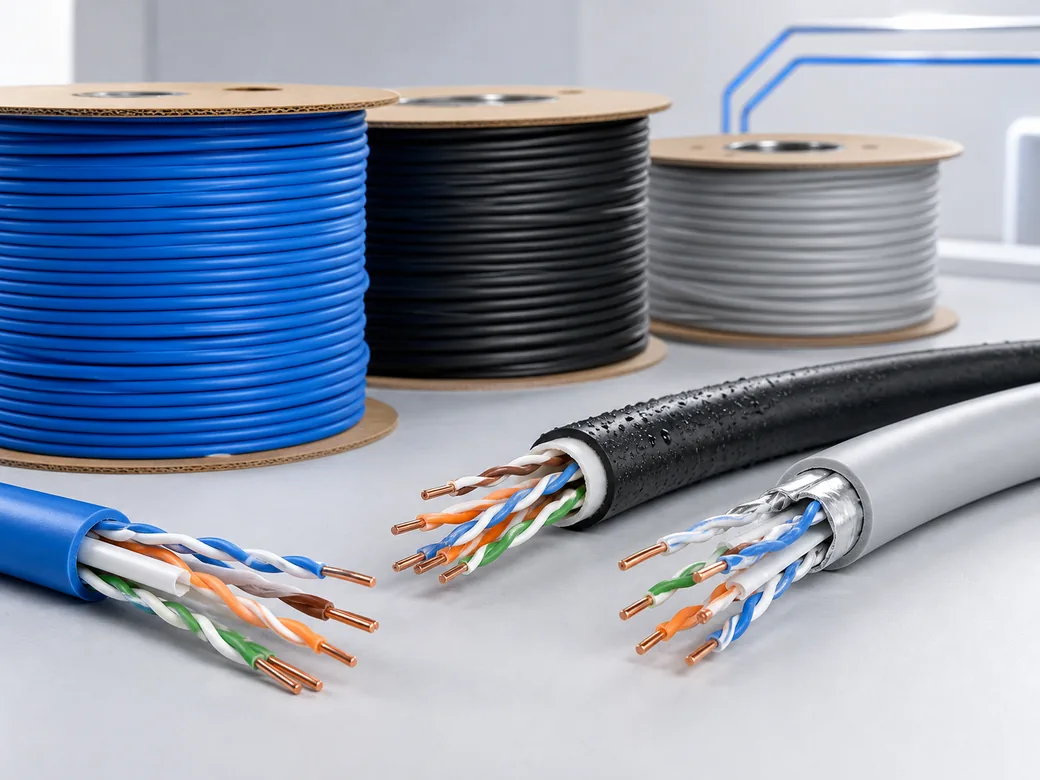
A request for “305m network cable” describes package length, not a complete cable. Two boxes can both contain 305 metres while differing in category, conductor, shielding, insulation, jacket, diameter, marking and test requirements. A useful quotation begins with a controlled specification every supplier reads the same way.
Define the application first
Record whether the project is a fixed horizontal link, equipment-room run, distributor stock item or OEM program. Note environment, pathway, termination hardware and project specification. The application guides construction decisions and prevents selection only by price per box.
Cable normally terminates into jacks or panels, so conductor dimensions and construction must match those components. Include accepted conductor range and cable-diameter limits when the connectivity system is selected.
Core specification fields
Category and performance
State the Ethernet category and project test basis. Avoid placing several categories under one ambiguous item. Acceptance documents should follow the agreed construction.
Conductor
Confirm solid or stranded construction, conductor material and size. Fixed cabling and flexible cords have different priorities. Do not substitute without checking installation and termination.
Pair and insulation
Specify insulation, pair arrangement and any separator. These details influence dimensions and transmission behaviour.
Shielding
Identify UTP, FTP or the exact arrangement. “Shielded cable” is not enough to compare materials or termination. Consider grounding and compatible hardware.
Jacket and environment
Define jacket material, color and project-specific environment. Do not claim or print a rating unless it belongs to the approved specification and supporting documents.
Dimensions
Provide conductor diameter, insulation diameter and overall cable diameter or width. Dimensions affect termination hardware, managers and pathways.
Marking and packaging
Define jacket legend, OEM text, sequential length marking and print color. Confirm count direction and how usable length is verified. Approve a print sample when marking carries brand or project information.
For 305m, specify box or reel, payout direction, labels, barcode and export packaging when needed. Poor payout can waste installation time even when construction is correct.
The catalogue includes a 305m cable product. Use it as a discussion point, then provide exact construction and packaging. Browse the bulk cable category for the sourcing page.
Quotation comparison
| Field | Buyer provides | Supplier confirms |
|---|---|---|
| Application | Installation and environment | Construction and limits |
| Performance | Category and tests | Specification and report |
| Conductor | Type, material and size | Construction and tolerance |
| Shielding | Exact arrangement | Shield elements |
| Jacket | Material and color | Proposed jacket |
| Marking | Legend and length format | Print sample |
| Packaging | Format and labels | Dimensions and payout |
Compatibility with jacks and plugs
Review construction with termination components. Solid bulk cable is commonly terminated to compatible IDC contacts, while modular plugs must suit conductor and cable geometry. Review keystone jacks and RJ45 plugs when defining a system.
Sample approval checklist
- Verify conductor, insulation, pair and shielding against the drawing.
- Measure dimensions and inspect jacket.
- Approve legend and sequential marking.
- Terminate with intended hardware.
- Review agreed test information.
- Check payout, box, labels and length.
- Record sample and drawing revision.
Common RFQ mistakes
Common errors include specifying only category and length, leaving conductor unclear, saying “shielded” without a construction, omitting jacket requirements and comparing different packaging. Risk also increases when an approved sample is followed by an unreviewed change.
Frequently asked questions
Is 305m length enough to define a bulk Ethernet cable?
No. Category, conductor, shielding, insulation, jacket, dimensions, marking, tests and packaging must also be specified.
Should solid or stranded conductor be selected?
Select for the actual application and project specification.
What should be printed on the jacket?
Define brand or OEM text, category, construction or rating information, sequential marking and project identification.
What should be checked on a sample?
Check dimensions, construction, jacket, printing, length marking, packaging and agreed test report.
Documents and lot control
Decide which documents are required before requesting a quotation. The useful set may include an approved construction drawing, product specification, print artwork, packaging drawing and the electrical or transmission test report agreed for the order. Requesting undefined certificates creates confusion; naming the actual project requirement makes supplier responses comparable.
For production lots, use an item code and drawing revision that connect the cable, label and packaging to the approved specification. If conductor, shielding, jacket, dimensions or marking changes, treat it as a controlled revision rather than silently replacing the previous construction.
Incoming inspection should sample the fields that can drift or be mixed: package length, outer diameter, jacket color, legend, sequential marking, box label and termination fit. Store the approved sample and report with the purchasing record to give repeat orders a practical baseline.
Prepare a comparable RFQ
Send application, construction, dimensions, marking, quantity and packaging through the contact page. A drawing, sample or project specification keeps the quote aligned.

CUSTOMER DISCUSSION
Article Discussion
Read questions and experience from other customers, then add your own product or project feedback.
No published comments yet. Start the first useful discussion.
Sign in to comment
Registered customers use their account display name and can track moderation status from the account page.
Customer Login Create an Account